
Why Adversarial Systems Matter
Courts, settlements, and the constitutional importance of genuine opposition

At first glance, the controversy surrounding Donald Trump’s lawsuit against the IRS sounds like a fairly ordinary political dispute over money. Trump demanded billions. A massive settlement was reportedly negotiated. Critics called it outrageous. Supporters called it accountability.
But the deeper concern raised by a group of former federal judges is not primarily about the dollar amount.
It is about whether the constitutional machinery of the courts was used to create the appearance of an adversarial legal dispute at a point where meaningful adversity may no longer have existed.
That distinction matters.
The American legal system is built on the assumption that truth and fairness are best approached through structured conflict. Plaintiffs and defendants are expected to push against one another’s interests while judges referee the process rather than independently constructing the case themselves.
Courts are therefore not merely administrative venues for processing agreements. They exist to resolve genuine disputes between meaningfully adverse parties.
That is why the Constitution limits federal courts to hearing actual “cases or controversies.” The judiciary is not supposed to function as a general-purpose approval board for political arrangements, private understandings, or mutually convenient outcomes. A federal court derives its legitimacy from resolving real conflicts between parties with genuinely opposing interests.
Most of the time, this structure operates quietly in the background. People may disagree with verdicts or settlements, but the legitimacy of the process itself remains largely intact because the opposing sides are understood to be meaningfully independent from one another.
The controversy surrounding Trump’s IRS settlement has drawn attention because critics argue that this adversarial structure may have begun collapsing in on itself.
The concern is not necessarily that every participant acted with corrupt intent. Nor is it necessary to prove some elaborate secret conspiracy for the institutional problem to become visible. The issue is more structural than cinematic.
A president sued agencies within the executive branch he oversees. Government lawyers representing those agencies were themselves part of the same executive branch. A settlement reportedly emerged containing terms that appeared unusually favorable not only financially, but potentially in ways affecting future tax enforcement involving Trump, his family, and related entities. The lawsuit was then voluntarily dismissed before substantial judicial scrutiny could fully test the arrangement.
The controversy becomes easier to understand once the institutional relationships are viewed structurally rather than politically.
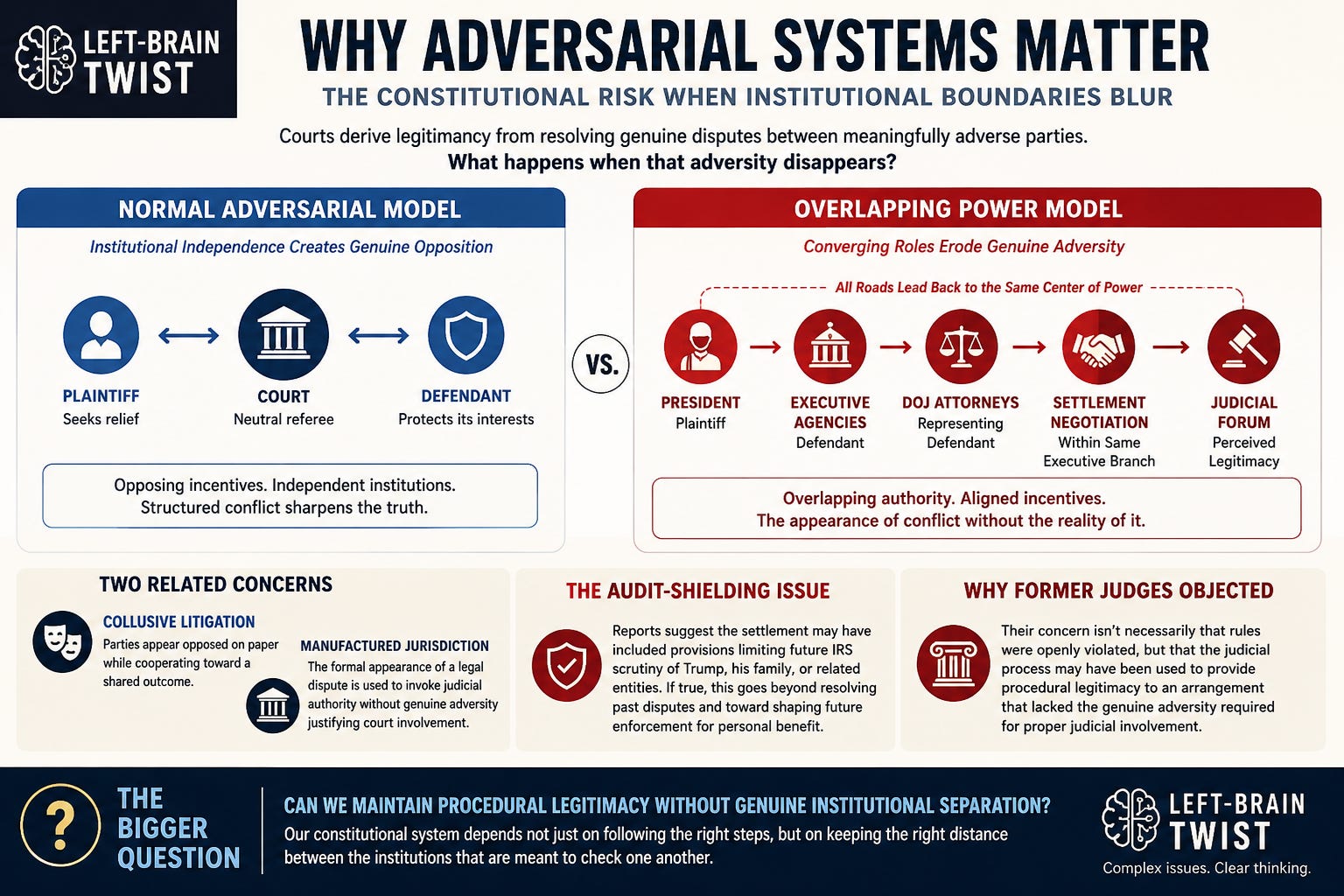
Viewed individually, each component has at least some plausible procedural explanation. Lawsuits settle. Presidents oversee executive agencies. Courts process dismissals every day.
But constitutional systems are not judged solely by whether each isolated step can be explained on its own.
They are also judged by whether the system as a whole still functions in the manner its safeguards were designed to ensure.
And that brings us to the core question underlying the former judges’ objections:
What happens when institutions designed to check one another begin operating less like opposing forces and more like overlapping extensions of the same sphere of influence?
Why Courts Require Adversarial Parties
The American judicial system does not assume judges are omniscient. It assumes they are dependent on process.
That process is adversarial by design.
Rather than asking judges to independently investigate every factual dispute or policy question, the system relies on opposing parties to aggressively test each other’s claims. Plaintiffs present arguments favorable to themselves. Defendants resist those arguments and expose weaknesses where possible. Each side has incentives to challenge exaggerations, dispute unsupported claims, and prevent outcomes harmful to their interests.
Ideally, this structured conflict sharpens the truth.
The judge’s role is not to act as a lone detective standing above the process. The judge functions more like a referee overseeing a contest between genuinely competing parties operating under shared procedural rules.
This is why the Constitution limits federal courts to hearing actual “cases or controversies” under Article III. That phrase is not merely technical language. It reflects a foundational principle about the proper role of the judiciary within the constitutional system.
Federal courts are not supposed to issue advisory opinions about hypothetical disputes. Nor are they intended to serve as ceremonial validators for arrangements the parties already mutually desire. Courts derive legitimacy from resolving genuine legal conflicts between parties with sufficiently adverse interests to ensure the dispute is real.
Without meaningful adversity, much of the justification for judicial involvement begins to weaken.
That principle becomes especially important in settlement negotiations.
Courts generally encourage settlements because litigation is expensive, uncertain, and time-consuming. Most lawsuits in America never reach trial. That alone is not suspicious. In fact, compromise is often evidence that the system is functioning pragmatically.
But settlements still depend on the assumption that each side enters negotiations attempting to protect its own interests. The plaintiff seeks compensation or concessions. The defendant seeks to minimize liability or avoid risk. Even when both sides ultimately compromise, the legitimacy of the outcome rests partly on the assumption that meaningful resistance existed throughout the process.
The concern raised by Trump’s IRS settlement is not simply that a settlement occurred.
It is whether enough genuine institutional independence remained for the adversarial framework itself to retain credibility.
How Settlements Normally Work
To understand why critics view this case differently, it helps to first understand what settlements are supposed to accomplish within an adversarial legal system.
Most lawsuits are not resolved through dramatic courtroom verdicts. They end through negotiated agreements between the parties. That is not a flaw in the system. In many cases, it is a sign that the system is functioning efficiently.
Trials are expensive, time-consuming, unpredictable, and risky for everyone involved. Even a party confident in its legal position may choose settlement to avoid years of litigation costs or the uncertainty of how a judge or jury might ultimately rule. Defendants often settle to cap financial exposure. Plaintiffs settle to secure guaranteed compensation rather than gamble on a larger but uncertain judgment.
Importantly, settlements do not necessarily mean either side was “right” or “wrong.” They often reflect a practical calculation about risk, cost, time, and institutional priorities.
Courts generally encourage such resolutions for precisely that reason.
But the legitimacy of settlements depends heavily on the assumption that the parties are genuinely independent from one another and are negotiating against opposing incentives.
That resistance acts as a safeguard.
It helps prevent settlements from becoming vehicles for hidden coordination, preferential treatment, or mutual self-interest disguised as legal resolution. The court does not usually need to investigate every negotiation from scratch because the adversarial structure itself provides much of the system’s built-in reliability.
This is also why collusive litigation has long been viewed with suspicion in American law.
If parties are not truly adverse — if they are cooperating toward a shared objective while merely presenting the outward form of conflict — then the judicial process can begin serving a fundamentally different purpose than the Constitution intended.
This is where concepts such as “collusive litigation” and “manufactured jurisdiction” enter the discussion.
Collusive litigation refers to situations in which parties appear formally opposed on paper while quietly cooperating toward a shared outcome. Courts have historically viewed such arrangements with suspicion because they undermine the adversarial process the judiciary depends upon to reliably test claims and preserve institutional neutrality.
Manufactured jurisdiction is a related concern. It refers to situations in which the formal appearance of a legal dispute is used to invoke judicial authority even though the underlying conflict may not be sufficiently genuine or adversarial to justify meaningful court involvement in the first place.
The danger is not merely that parties eventually agree with one another. Settlements involve agreement all the time. The concern arises when the judicial process itself begins functioning less as a mechanism for resolving conflict and more as a vehicle for conferring procedural legitimacy on outcomes the parties already mutually desire.
That concern does not arise every time parties settle. It arises when the independence of the parties themselves becomes difficult to clearly distinguish.
And that is the structural problem critics believe may have emerged in Trump’s IRS case.
The Structural Problem
At the center of the controversy is a deceptively simple question:
How adversarial can a lawsuit remain when the same political figure effectively sits atop multiple parts of the system simultaneously?
Under normal circumstances, the structure is relatively straightforward. A private litigant sues the government. Government attorneys defend the government’s interests. The court acts as a neutral referee between the two.
The institutional separation between those roles is what gives the process credibility.
But the lines become far less clear when the plaintiff is also the President of the United States.
Trump was not merely a private citizen bringing claims against a distant federal bureaucracy. He was simultaneously the head of the executive branch overseeing the very agencies involved in the dispute. The Department of Justice attorneys representing the government ultimately operated within the same executive hierarchy headed by Trump himself. The IRS likewise falls under executive branch authority.
Viewed narrowly, defenders can point out — correctly — that institutional roles still formally existed. Government lawyers retained professional obligations. Agencies retain internal procedures and career personnel. Presidents do not personally negotiate every lawsuit involving the federal government.
But constitutional systems depend not only on formal boxes remaining visible on an organizational chart. They also depend on sufficient institutional separation between those boxes to preserve confidence that each is still functioning independently.
That distinction is critical.
The concern raised by the former judges is not simply that Trump occupied overlapping roles within the system. Presidents inevitably do. The deeper concern is whether enough meaningful resistance remained within the structure for the adversarial process itself to retain legitimacy.
In other words, were the parties still meaningfully acting against one another’s interests, or had the structure begun collapsing into something more coordinated than adversarial?
That question became sharper as reports emerged about the settlement itself. A large financial payout alone would already have attracted scrutiny given the extraordinary scale of the original claims. But critics focused especially on reports that the agreement may have included provisions limiting or discouraging future IRS scrutiny involving Trump, his family, or related entities.
If accurate, that moves the controversy beyond ordinary settlement dynamics.
Traditional settlements typically resolve past disputes. They compensate for alleged harms already claimed to have occurred. What made this arrangement appear structurally different to critics was the perception that the settlement may also have shaped future enforcement posture involving politically connected parties.
That is where the appearance of collusion becomes difficult for many observers to ignore — even without proving criminal conspiracy or explicit bad faith.
No single component necessarily looks fatal in isolation. Lawsuits settle. Presidents oversee executive agencies. Government lawyers negotiate agreements. Cases are voluntarily dismissed every day.
But constitutional safeguards are rarely tested by isolated components examined one at a time.
They are tested by how those components interact when concentrated around the same center of political power.
And that is the broader concern underlying the former judges’ objections: not merely whether a settlement occurred, but whether the constitutional logic of adversarial process remained intact once the system’s overlapping institutional roles began converging around the same individual.
Why the Former Judges Objected
The objections raised by the former federal judges were not primarily framed as a dispute over politics or even over the size of the settlement itself. Their concern was more institutional than partisan.
At the heart of their argument was the belief that the federal courts may have been used to provide procedural legitimacy to an arrangement that lacked the degree of genuine adversity required for proper judicial involvement.
That distinction matters because courts derive much of their authority not from force, but from trust in the integrity of the process. The judiciary possesses neither the power of the executive branch nor the direct lawmaking authority of Congress. Its legitimacy rests heavily on public confidence that courts are resolving actual disputes between genuinely opposing parties under neutral procedural rules.
The former judges appear to argue that this principle was placed under strain in Trump’s IRS litigation.
Their concern was not necessarily that every participant knowingly engaged in corruption or unlawful conduct. Nor did the objections depend on proving some hidden conspiracy operating behind closed doors. The issue they raised was more structural and constitutional in nature.
Specifically, they questioned whether the lawsuit retained enough meaningful adversity to satisfy the constitutional purpose underlying federal judicial power.
The danger is not merely that the parties may agree with one another. Settlements involve agreement all the time. The danger arises when the judicial process itself becomes less a mechanism for resolving conflict and more a vehicle for laundering legitimacy through the appearance of conflict.
In practical terms, critics fear that courts can become props in a process rather than independent arbiters of one.
That concern appears particularly relevant here because the lawsuit was reportedly voluntarily dismissed before substantial judicial scrutiny could fully examine either the underlying legal claims or the settlement structure itself. According to reports, the presiding judge noted that no formal settlement had actually been entered into the court record for judicial approval.
That detail complicates the issue in important ways.
On one hand, defenders of the settlement can argue that the court never formally approved or endorsed the arrangement. If the settlement existed outside a judicial order or consent decree, then the judiciary never officially ratified the agreement or placed its authority behind its terms.
From that perspective, accusations that the courts were improperly used to “bless” the settlement overstate the judiciary’s actual involvement.
On the other hand, critics argue that the existence of the lawsuit itself still provided institutional cover and procedural legitimacy. The federal court system became part of the narrative framework surrounding the agreement even if the judge never formally approved its terms.
That distinction may sound subtle, but it cuts to the heart of the institutional concern.
The former judges’ objections ultimately appear less focused on proving explicit wrongdoing than on defending the constitutional logic underlying adversarial judicial process itself. Their warning is not simply about one settlement, but about the long-term erosion that can occur when formal legal structures remain intact while the institutional separation those structures depend upon begins to weaken.
The Audit-Shielding Issue
If the concerns about adversarial structure formed the constitutional foundation of the controversy, the reported audit-related provisions supplied the emotional and institutional accelerant.
Large settlements alone do not necessarily imply corruption or abuse. Governments sometimes settle major claims for pragmatic reasons, including litigation risk, political pressure, reputational concerns, or the desire to avoid prolonged legal uncertainty.
But critics viewed the reported provisions involving future IRS scrutiny differently because they appeared to move beyond resolving past disputes and into shaping future enforcement behavior.
That distinction is crucial.
Ordinarily, settlements are backward-looking. They attempt to resolve alleged harms that have already occurred. Money changes hands. Claims are released. Litigation ends. The legal system moves on.
The controversy here emerged because reports suggested the agreement may also have included provisions discouraging, limiting, or otherwise constraining future tax enforcement activity involving Trump, his family, or related entities.
Whether those reports ultimately prove fully accurate matters enormously. But even the perception of such protections fundamentally changes how many observers interpret the settlement structure.
Why?
Because the issue ceases to look like ordinary litigation resolution and begins resembling selective insulation from future governmental scrutiny.
That creates a different category of constitutional concern altogether.
The American legal system depends heavily on the principle that laws and enforcement mechanisms apply through stable institutional processes rather than personalized political relationships. The IRS is already one of the most politically sensitive agencies in the federal government precisely because tax enforcement carries enormous coercive power. Public trust in its legitimacy depends on the belief that enforcement decisions are not being manipulated to reward allies or shield politically connected figures.
Critics argue that this is where the settlement becomes especially difficult to separate from broader concerns about executive self-interest.
A president occupying overlapping roles within the executive branch is already a structurally delicate situation. But when a settlement reportedly appears to affect future enforcement posture involving the president’s own financial interests, critics see the institutional boundaries becoming even more blurred.
Importantly, one does not need to prove explicit corruption to recognize why this appearance troubles many observers.
Constitutional systems are designed not merely to prevent outright criminality, but to reduce circumstances in which concentrated power creates incentives for favoritism, self-protection, or diminished institutional independence. Much of constitutional governance operates through maintaining public confidence that legal processes remain meaningfully separate from personal political interests.
That is why appearance matters here almost as much as provable intent.
Even if every individual actor involved could articulate a defensible procedural justification for their role, the cumulative structure still risks creating the perception that the machinery of government is bending toward the protection of politically connected insiders rather than operating through neutral institutional principles.
And once public trust in those principles begins eroding, the damage rarely remains confined to a single case.
The Bigger Question: Procedural Legitimacy vs. Genuine Institutional Separation
At its core, the controversy surrounding Trump’s IRS settlement is not simply a dispute about money, tax enforcement, or even presidential behavior.
It is a question about the difference between procedural legitimacy and genuine institutional separation.
Those two concepts are related, but they are not identical.
Procedural legitimacy concerns whether the visible steps of the system appear to have been followed correctly. Were lawyers involved? Was a lawsuit filed? Did the parties operate through recognized legal channels? Was the case processed through an actual federal court rather than some entirely extralegal arrangement?
On paper, much of the structure surrounding this case appears recognizable. Formal institutional roles existed. The lawsuit moved through legal procedures. Government attorneys represented executive agencies. The case was ultimately dismissed through established mechanisms available within the judicial system.
But constitutional systems rely on more than recognizable procedures alone.
They also depend on institutions maintaining sufficient separation from one another to preserve public confidence that those procedures still represent genuinely independent judgment rather than overlapping political influence operating through formal channels.
That distinction becomes especially important in a constitutional system built around divided power.
The American framework was not designed merely to create procedures. It was designed to distribute authority across institutions expected to partially resist one another’s interests and ambitions. Courts, executive agencies, Congress, prosecutors, and enforcement bodies all possess different responsibilities not simply for administrative convenience, but to reduce the risk that concentrated power begins serving personal or factional interests unchecked.
Most of the time, those institutional boundaries operate quietly enough that the public barely notices them. But controversies like this one draw attention precisely because they place stress on the assumptions underlying the system itself.
The concern raised by the former judges is not necessarily that every rule was openly violated in some dramatic fashion. In fact, the more unsettling possibility may be the opposite: that enough procedural normalcy remained visible for the arrangement to move through the system while deeper questions about institutional independence became increasingly difficult to answer clearly.
That is why this controversy resonates beyond the specifics of tax litigation.
It touches a broader constitutional anxiety increasingly visible across modern political life: whether institutions designed to check concentrated power can continue functioning credibly when the same political gravity begins pulling multiple parts of the system into overlapping orbit around itself.
That concern is not unique to one president, one party, or one lawsuit. Constitutional systems are always vulnerable to periods in which formal processes remain intact while the independence those processes are meant to safeguard becomes more ambiguous.
And once ambiguity about institutional independence begins growing, public trust becomes harder to sustain.
Not because citizens expect perfection.
But because they expect the system’s safeguards to remain meaningfully separate from the personal interests of those operating within them.
Closing
Reasonable people can disagree about the merits of Trump’s original lawsuit, the appropriateness of the settlement amount, or even whether the reported audit-related provisions crossed legal or ethical lines.
But the controversy surrounding the case ultimately raises a deeper question than whether one side “won” the litigation.
It asks whether adversarial constitutional systems can continue functioning properly when the same political figure increasingly occupies overlapping positions across multiple stages of the process itself.
Courts depend not only on procedure, but on confidence that the institutions participating in the process remain meaningfully separate from one another.
That confidence weakens when those boundaries begin to blur.
Individually, each component of this case appears recognizable enough. Lawsuits settle. Presidents oversee executive agencies. Courts process dismissals every day.
But constitutional safeguards are rarely tested by isolated facts standing alone.
They are tested by the cumulative interaction of power, incentives, and institutional structure.
And that is why the objections raised by the former federal judges matter even beyond this specific controversy. Their warning is not merely about one settlement or one president.
It is about preserving the distinction between institutions that remain procedurally connected to the Constitution and institutions that remain meaningfully independent enough to fulfill the constitutional purposes they were designed to serve.